NASA Hubble Telescope Reveals Stunning Time-Lapse Movies of Stellar Jets
Introduction
For decades, astronomers could only study still images of star formation. But now, thanks to the powerful Hubble Space Telescope, scientists have created incredible time-lapse movies that reveal how stars are born in real-time.
This breakthrough research, led by Patrick Hartigan from Rice University, provides an unprecedented look at the early stages of stellar evolution—helping us better understand how stars like our Sun came into existence.
The Birth of Stars: A Powerful Cosmic Process
Stars don’t quietly come into existence—they announce their birth dramatically.
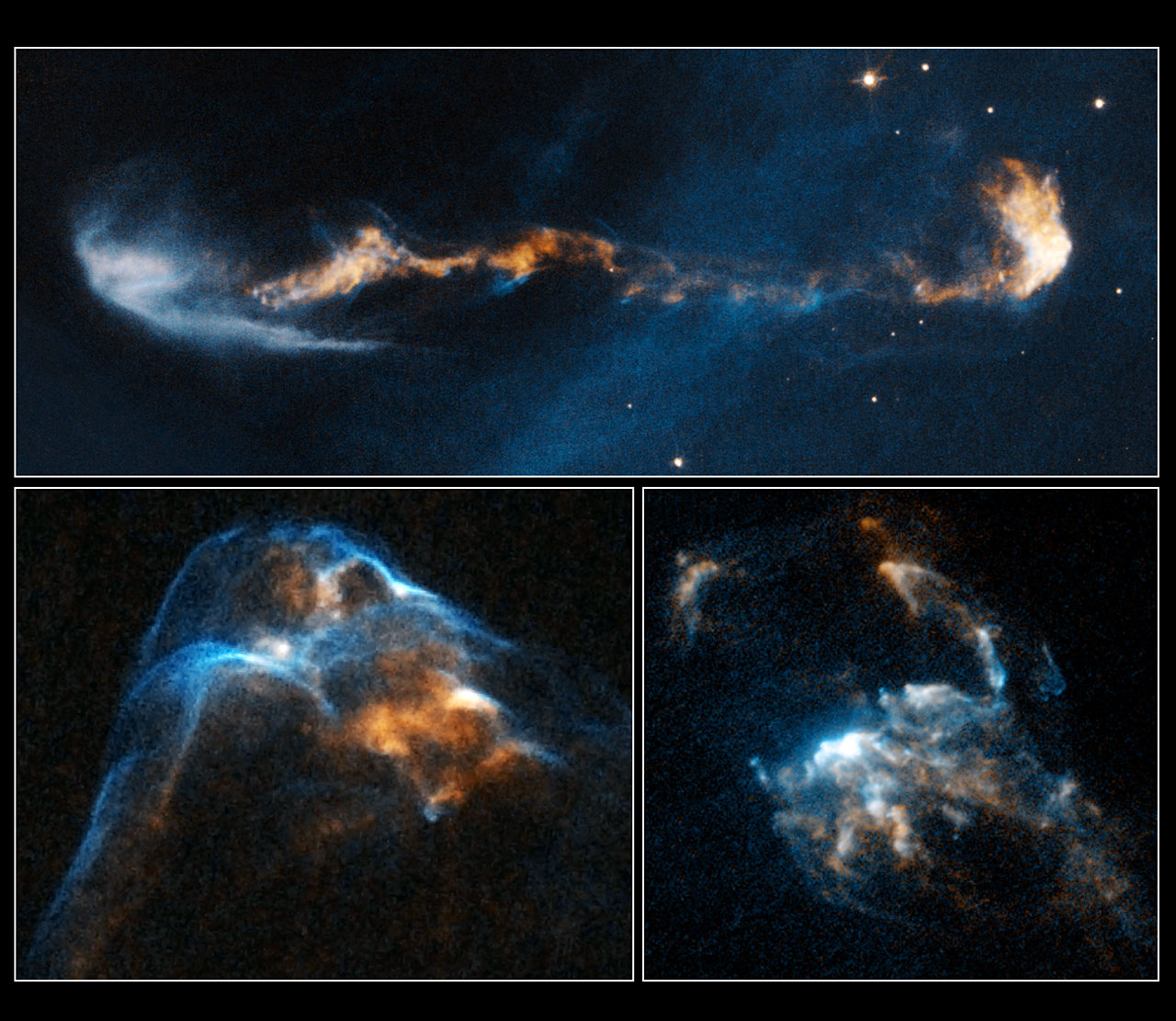
When a new star forms, it releases powerful jets of glowing gas that shoot out into space at supersonic speeds. These jets travel in opposite directions, cutting through the surrounding cosmic environment.
These phenomena are known as Herbig-Haro Objects, named after astronomers who first studied them in the 1950s.
Hubble’s Time-Lapse Movies: A Game Changer
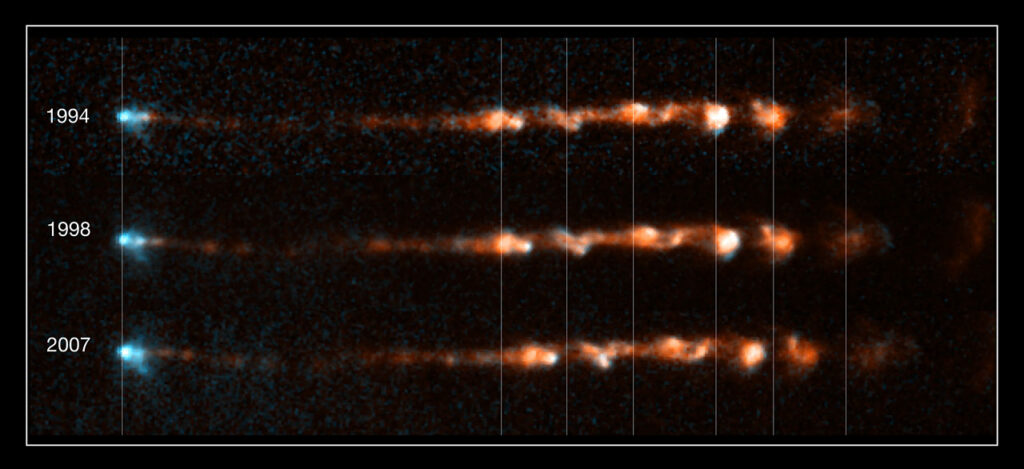
Using over 20 years of observations, scientists combined high-resolution images from Hubble to create time-lapse movies of stellar jets.
Unlike most astronomical events—which take millions of years—these jets evolve over just a few years, making them perfect for real-time observation.
The movies show:
- Fast-moving gas streams traveling over 700,000 km/h
- Bright knots of gas appearing and fading
- Collisions between fast and slow-moving material
- Shockwaves forming glowing arrowhead shapes
These insights reveal how young stars interact with their surroundings—something never seen before.
A Glimpse Into Our Sun’s Past
The findings give scientists a rare opportunity to look back in time—essentially showing how our own Sun behaved about 4.5 billion years ago.
The jets act like a “cosmic record,” capturing moments when material falls into the star and is violently ejected back into space.
How Stars Form (Simple Explanation)
This research changes how we understand star formation:
- Reveals real-time evolution of stellar jets
- Improves accuracy of computer simulations
- Helps scientists understand planetary system formation
- Provides clues about our cosmic origins
It also shows how combining space observations with lab experiments can unlock the mysteries of the universe.
Star formation begins inside massive clouds of cold hydrogen gas. Here’s how it works:
- Gravity pulls gas together → forming a dense core
- A young star begins to form at the center
- A spinning disk of gas and dust develops around it
- Material from the disk falls into the star
- Excess energy is released as high-speed jets
Eventually, this disk may form planets—just like our Solar System.
Key Regions Observed by Hubble
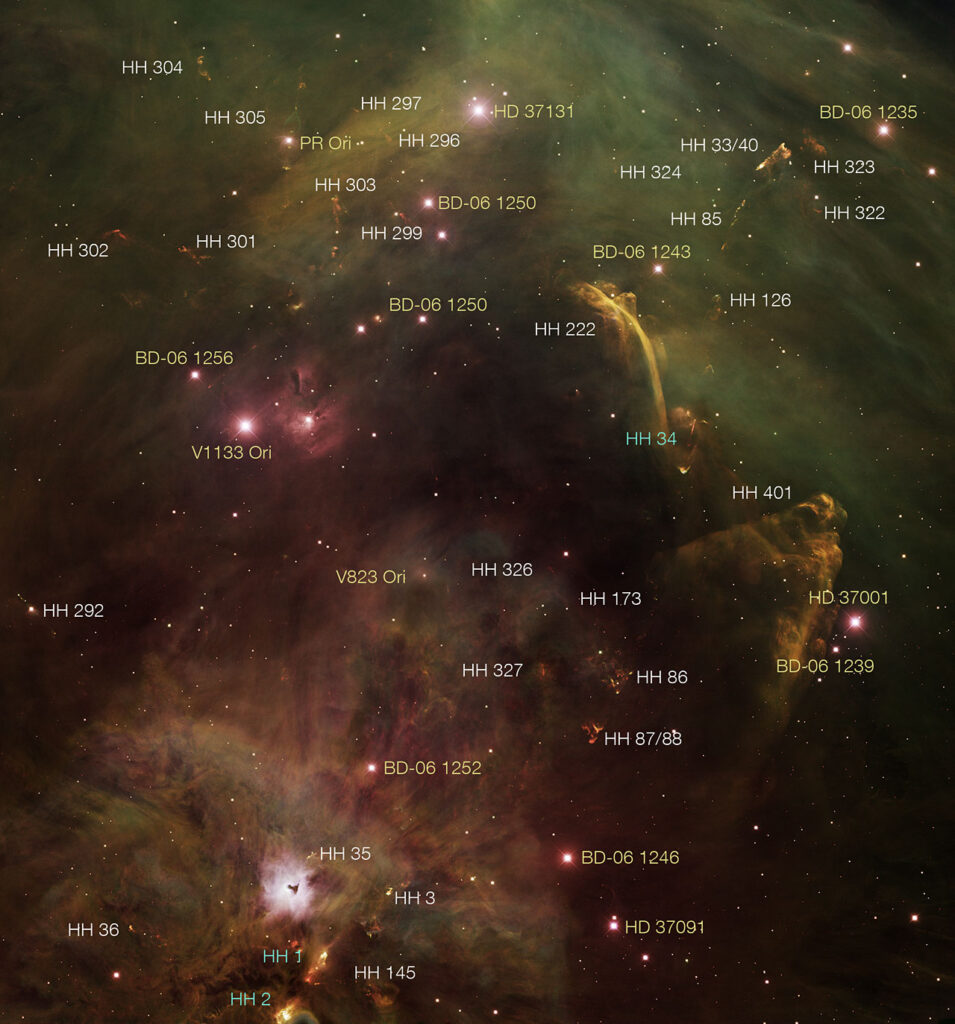
Hubble studied several famous jet systems, including:
- HH 1
- HH 2
- HH 34
- HH 46
- HH 47
Some of these are located near the stunning Orion Nebula, one of the most active star-forming regions visible from Earth.
What Makes These Jets Unique?
The movies revealed something surprising:
The jets are not continuous streams
Instead, they are released in bursts or clumps
This clumpy structure behaves like traffic on a highway:
- Faster gas crashes into slower gas
- This creates bow shocks (glowing wave-like structures)
- These shocks heat up and then cool over time
This discovery challenges earlier models that assumed smooth, steady jets.
Science Meets Technology
To better understand these cosmic events, scientists collaborated with experts from:
- Los Alamos National Laboratory
- Atomic Weapons Establishment
- General Atomics
- University of Rochester
They even recreated jet-like conditions using powerful laser facilities like:
- Omega Laser Facility
These experiments help scientists simulate how supersonic jets behave in space—right here on Earth.
Why This Discovery Matters
This research changes how we understand star formation:
- Reveals real-time evolution of stellar jets
- Improves accuracy of computer simulations
- Helps scientists understand planetary system formation
- Provides clues about our cosmic origins
It also shows how combining space observations with lab experiments can unlock the mysteries of the universe.
Conclusion
The Hubble Space Telescope has once again proven why it’s one of the most important tools in modern astronomy.
By turning decades of data into stunning time-lapse movies, scientists have opened a new window into the birth of stars—giving us a clearer picture of how our universe, and even our Sun, came to be.
Notes & Credits
The Hubble Space Telescope is a result of international collaboration between NASA and European Space Agency, combining advanced technology and global scientific expertise to explore the universe.
Research Team
This groundbreaking study was conducted by an international team of astronomers and scientists, including:
- Patrick Hartigan – Rice University
- Adam Frank – University of Rochester
- John Foster – Atomic Weapons Establishment
- Paula Rosen – Atomic Weapons Establishment
- Bernie Wilde – Los Alamos National Laboratory
- Rob Coker – Los Alamos National Laboratory
- Melissa Douglas – Los Alamos National Laboratory
- Brent Blue – General Atomics
Freddy Hansen – General Atomics
Image Credit
All images and visual data used in this research are credited to:
👉 NASA
👉 European Space Agency
👉 Patrick Hartigan